#include <Mixed.hpp>
Public Member Functions | |
| Mixed (size_t size) | |
| Class constructors to initialize object. | |
| virtual void | set_p (double ucom, double bfield, double betaeff, double r, double fsc) |
| Methods to set momentum/energy arrays and number density arrays. | |
| virtual void | set_p (double gmax) |
| Same as above, but assuming a fixed maximum Lorentz factor. | |
| virtual void | set_ndens () |
| virtual void | set_temp_kev (double T) |
| virtual void | set_norm (double n) |
| virtual void | set_plfrac (double f) |
| virtual void | set_plfrac (double Le, double r, double eldens) |
| virtual void | set_pspec (double s1) |
| virtual void | cooling_steadystate (double ucom, double n0, double bfield, double r, double betaeff) |
| virtual double | max_p (double ucom, double bfield, double betaeff, double r, double fsc) |
| virtual double | count_th_particles () |
| virtual double | av_th_p () |
| virtual double | av_th_gamma () |
| virtual double | count_pl_particles () |
| virtual double | av_pl_p () |
| virtual double | av_pl_gamma () |
| virtual double | K2 (double x) |
| Evaluate Bessel function for MJ normalization. | |
| virtual void | test () |
| simple method to check quantities. | |
 Public Member Functions inherited from kariba::Particles Public Member Functions inherited from kariba::Particles | |
| Particles (size_t size) | |
| int | get_cutoff_type () const |
| virtual void | set_cutoff_type (int t) |
| virtual void | set_mass (double m) |
| virtual void | initialize_gdens () |
| virtual void | initialize_pdens () |
| Same as above but the other way around. | |
| virtual void | differentiate () |
| virtual const std::vector< double > & | get_p () const |
| virtual const std::vector< double > & | get_pdens () const |
| virtual const std::vector< double > & | get_gamma () const |
| virtual const std::vector< double > & | get_gdens () const |
| virtual const std::vector< double > & | get_pdensp2_diff_logp () const |
| virtual double | count_particles () |
| Simple numerical integrals /w trapeze method. | |
| virtual double | count_particles_energy () |
| virtual double | av_p () |
| virtual double | av_gamma () |
| virtual double | av_psq () |
| virtual double | av_gammasq () |
| virtual void | test_arrays () |
| simple method to check arrays; only meant for debugging | |
Protected Attributes | |
| double | thnorm |
| double | theta |
| double | Temp |
| double | pspec |
| double | plnorm |
| double | pmin_th |
| double | pmax_th |
| double | pmin_pl |
| double | pcut_pl |
| double | pmax_pl |
| double | plfrac |
| Protected Attributes inherited from kariba::Particles | |
| double | mass_gr |
| particle mass in grams | |
| double | mass_kev |
| same as above but in keV, using electrons as "reference" | |
| std::vector< double > | p |
| array of particle momenta | |
| std::vector< double > | ndens |
| array of number density per unit volume, per unit momentum | |
| std::vector< double > | gamma |
| array of particle kinetic energies for each momentum | |
| std::vector< double > | gdens |
| array of number density per unit volume, per unit gamma | |
| std::vector< double > | pdensp2_diff_logp |
| density for radiation calculation p^-2*dn/dp | |
| int | cutoff_type = Exponential |
Friends | |
| double | th_num_dens_int (double x, void *p) |
| Methods to calculate number density and average energy in thermal part. | |
| double | av_th_p_int (double x, void *p) |
| double | pl_num_dens_int (double x, void *p) |
| Methods to calculate number density and average energy in non-thermal part. | |
| double | av_pl_p_int (double x, void *p) |
Additional Inherited Members | |
| Static Public Member Functions inherited from kariba::Particles | |
| static double | cutoff_factor (double x, int type=Exponential) |
Detailed Description
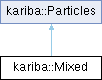
Class for mixed particles, inherited from the generic Particles class in Particles.hh the minimum momentum of the PL is always be assumed to be the averge momentum of the thermal note: ndens is number density per unit momentum
The reasons the integrands are friends is kind of magic. Basically, we need pointers to the private members Temp/thnorm/theta/whatever to set the parameters of the integrand functions in the GSL libraries. In C++ this is not possible for non-static private member functions (because otherwise we could access private members from the outside by using a pointer). To quote the compiler error, C++ forbids taking the address of an unqualified or parenthesized non-static member function to form a pointer to member function. And we need a pointer member function void *p to set up the integrands for GSL libraries. By using a friend function we can instead set up a set of parameters whose value is that of a pointer which points at the values stored in the private members; by doing this, we can not change the private members' values (correctly so) but we can still access their numerical value and use it elsewhere.
Constructor & Destructor Documentation
◆ Mixed()
| kariba::Mixed::Mixed | ( | size_t | size | ) |
Class constructors to initialize object.
Member Function Documentation
◆ av_pl_gamma()
|
virtual |
◆ av_pl_p()
|
virtual |
◆ av_th_gamma()
|
virtual |
◆ av_th_p()
|
virtual |
◆ cooling_steadystate()
|
virtual |
Method to solve steady state continuity equation. NOTE: KN cross section not included in IC cooling
◆ count_pl_particles()
|
virtual |
◆ count_th_particles()
|
virtual |
◆ K2()
|
virtual |
Evaluate Bessel function for MJ normalization.
◆ max_p()
|
virtual |
Method to calculate maximum momentum of non thermal particles based on acceleration and cooling timescales
◆ set_ndens()
|
virtual |
◆ set_norm()
|
virtual |
◆ set_p() [1/2]
|
virtual |
Same as above, but assuming a fixed maximum Lorentz factor.
◆ set_p() [2/2]
|
virtual |
Methods to set momentum/energy arrays and number density arrays.
◆ set_plfrac() [1/2]
|
virtual |
◆ set_plfrac() [2/2]
|
virtual |
◆ set_pspec()
|
virtual |
◆ set_temp_kev()
|
virtual |
methods to set the temperature, pl fraction, and normalizations. Temperature must be in ergs, no factor kb
◆ test()
|
virtual |
simple method to check quantities.
Friends And Related Symbol Documentation
◆ av_pl_p_int
|
friend |
◆ av_th_p_int
|
friend |
◆ pl_num_dens_int
|
friend |
Methods to calculate number density and average energy in non-thermal part.
◆ th_num_dens_int
|
friend |
Methods to calculate number density and average energy in thermal part.
Member Data Documentation
◆ pcut_pl
|
protected |
◆ plfrac
|
protected |
◆ plnorm
|
protected |
◆ pmax_pl
|
protected |
◆ pmax_th
|
protected |
◆ pmin_pl
|
protected |
◆ pmin_th
|
protected |
◆ pspec
|
protected |
◆ Temp
|
protected |
◆ theta
|
protected |
◆ thnorm
|
protected |
The documentation for this class was generated from the following files: